Data · Stories · Decisions
Data
Storytellingwith Artificial Intelligence
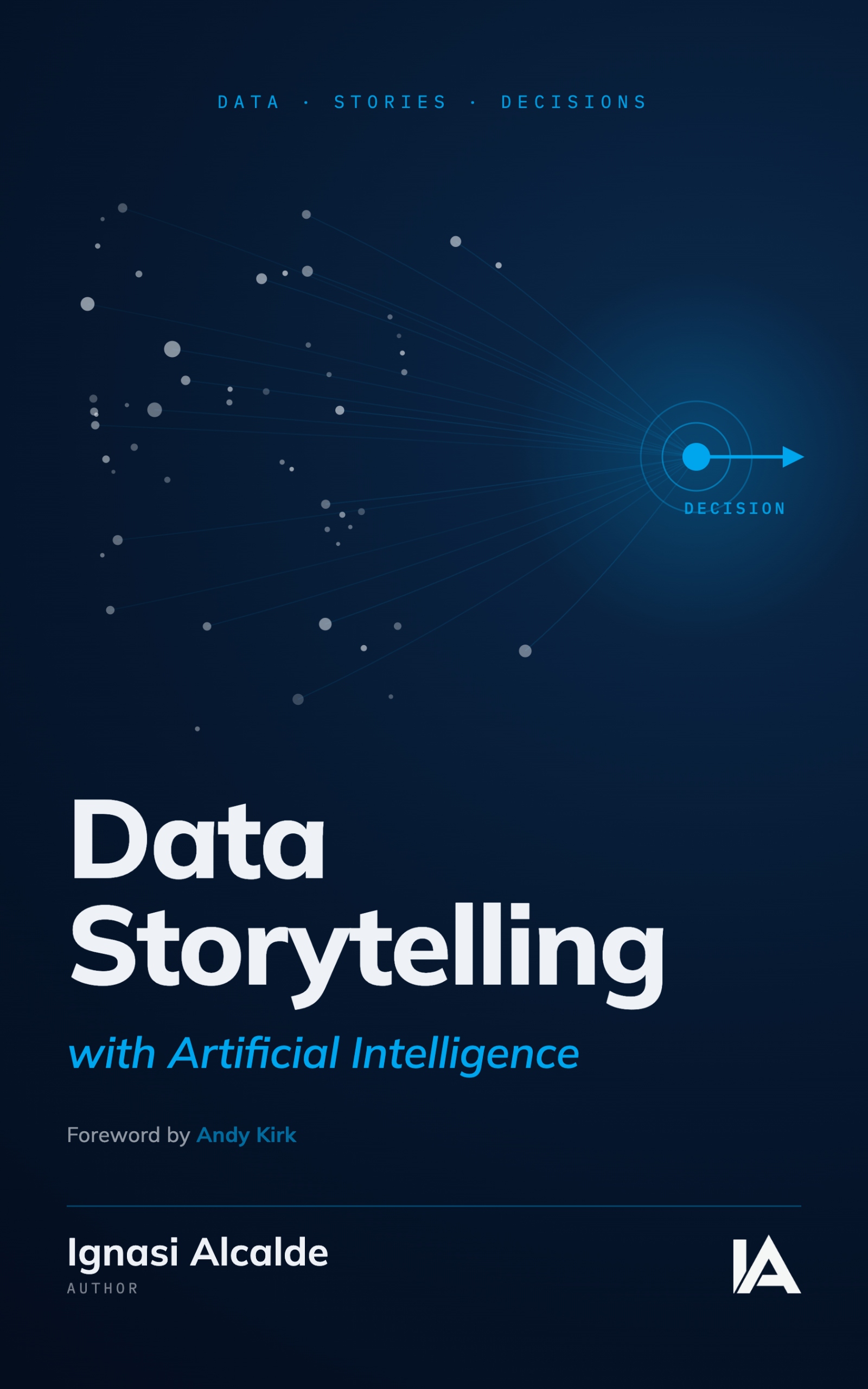
Artificial intelligence lets us analyze more, visualize faster and draft in seconds. Turning any of that into a decision still takes judgment.
Foreword by Andy Kirk · Visualising Data
The problem
Data doesn't make decisions. People do.
It's Monday morning. Someone shares the monthly dashboard: twenty indicators, a color palette, arrows pointing up and others down. Every figure seems important. Everyone nods. And when the meeting ends, you leave knowing more than when you walked in, but no clearer about what to do.
That scene isn't a failure of tooling. Most organizations don't have too little data. They have too much information, interpretation that never arrives, and findings that never turn into action. This book is about closing that gap, and about what generative AI can and cannot do to help.
The method
Four movements, in order
The work has a sequence. Skip a step and the analysis gets faster without getting better. AI helps inside each movement; the method is what directs the AI.
| AI is good at | You are accountable for |
|---|---|
| Listing the decisions a vague problem could become | Choosing which one is actually on the table |
| Spotting patterns faster than any team | Telling the relevant from the anecdotal |
| Drafting the sentence that names a finding | Checking the evidence holds it up |
| Producing options, risks and a first plan | Signing the decision and living with it |
Inside the book
Read a few pages
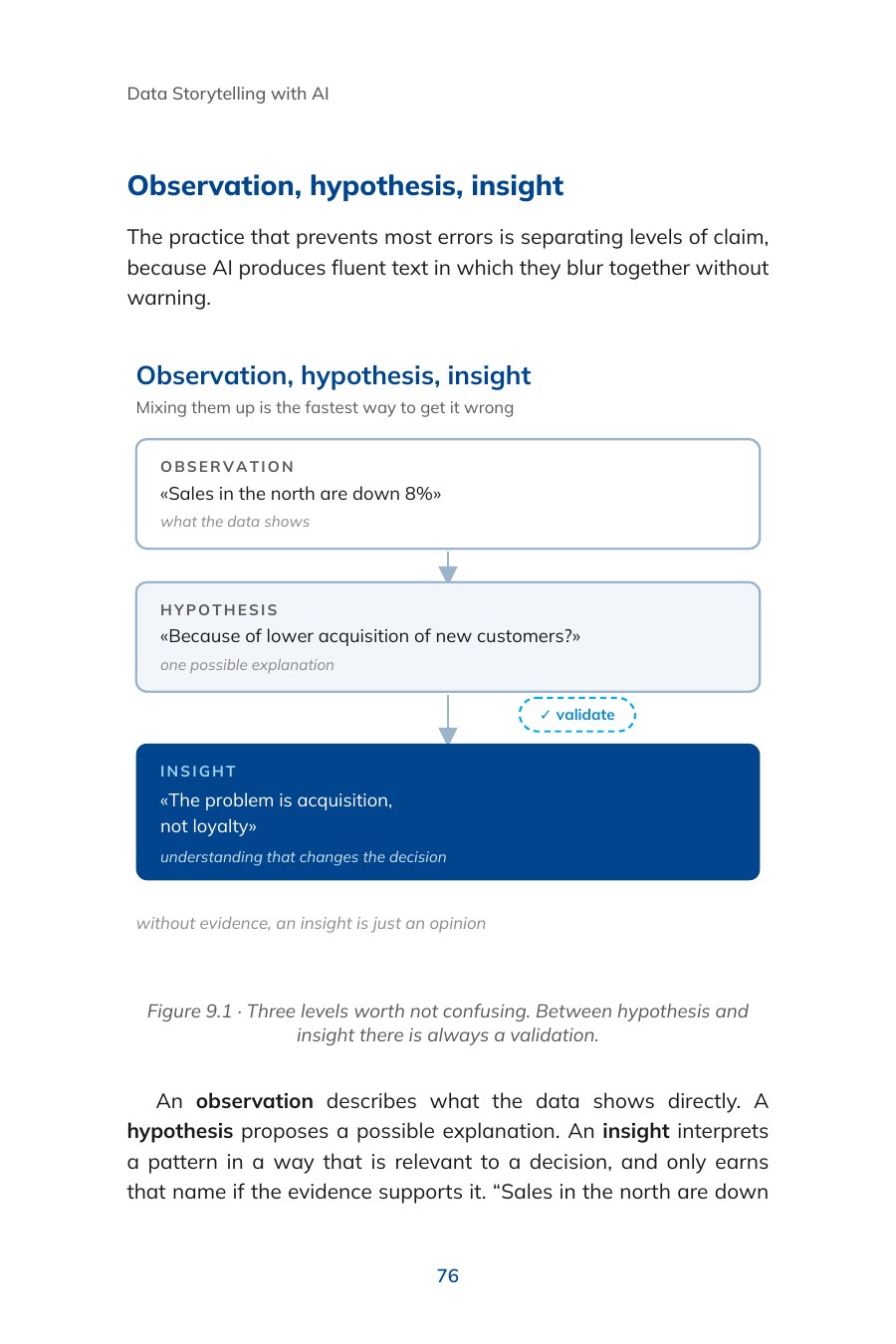
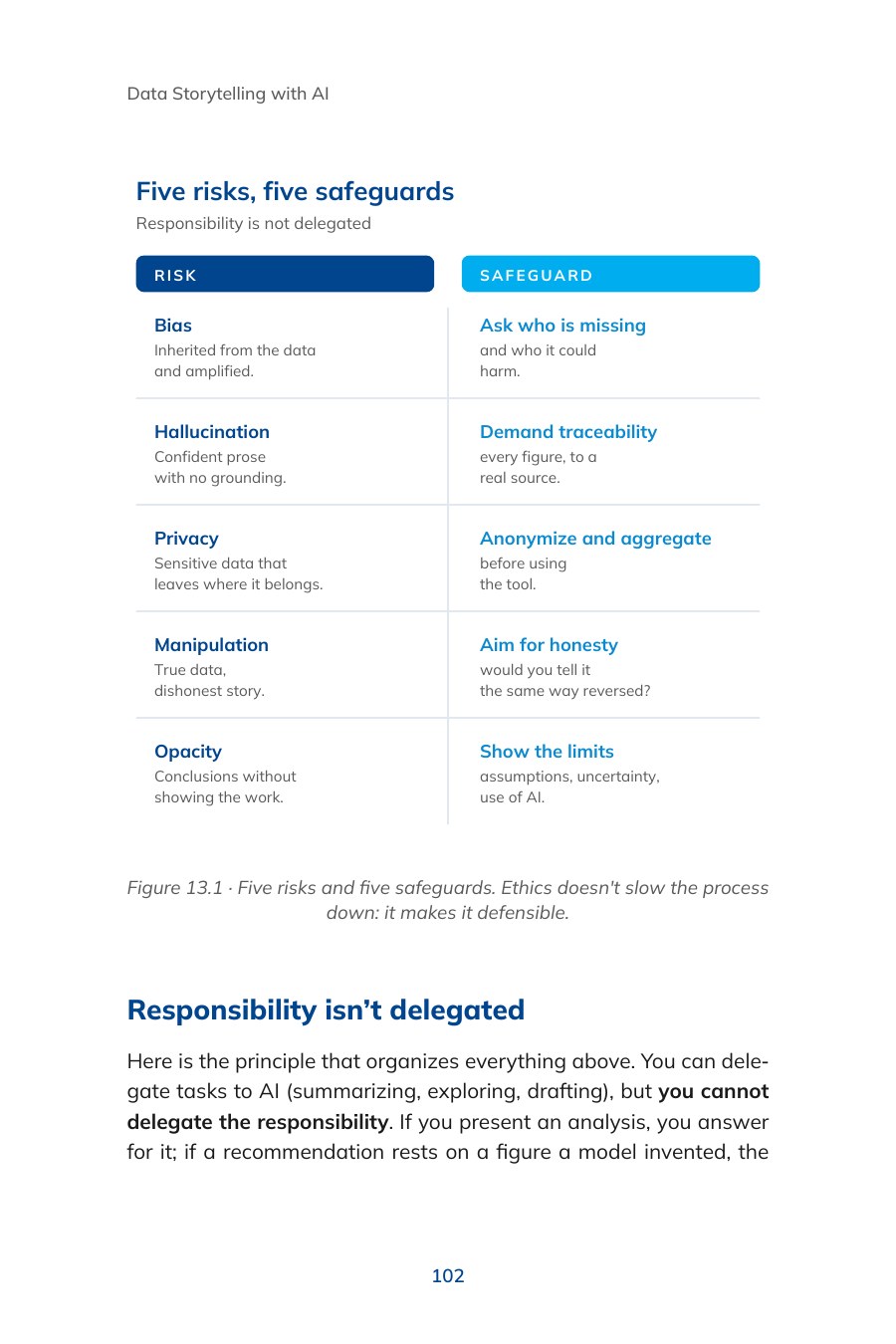
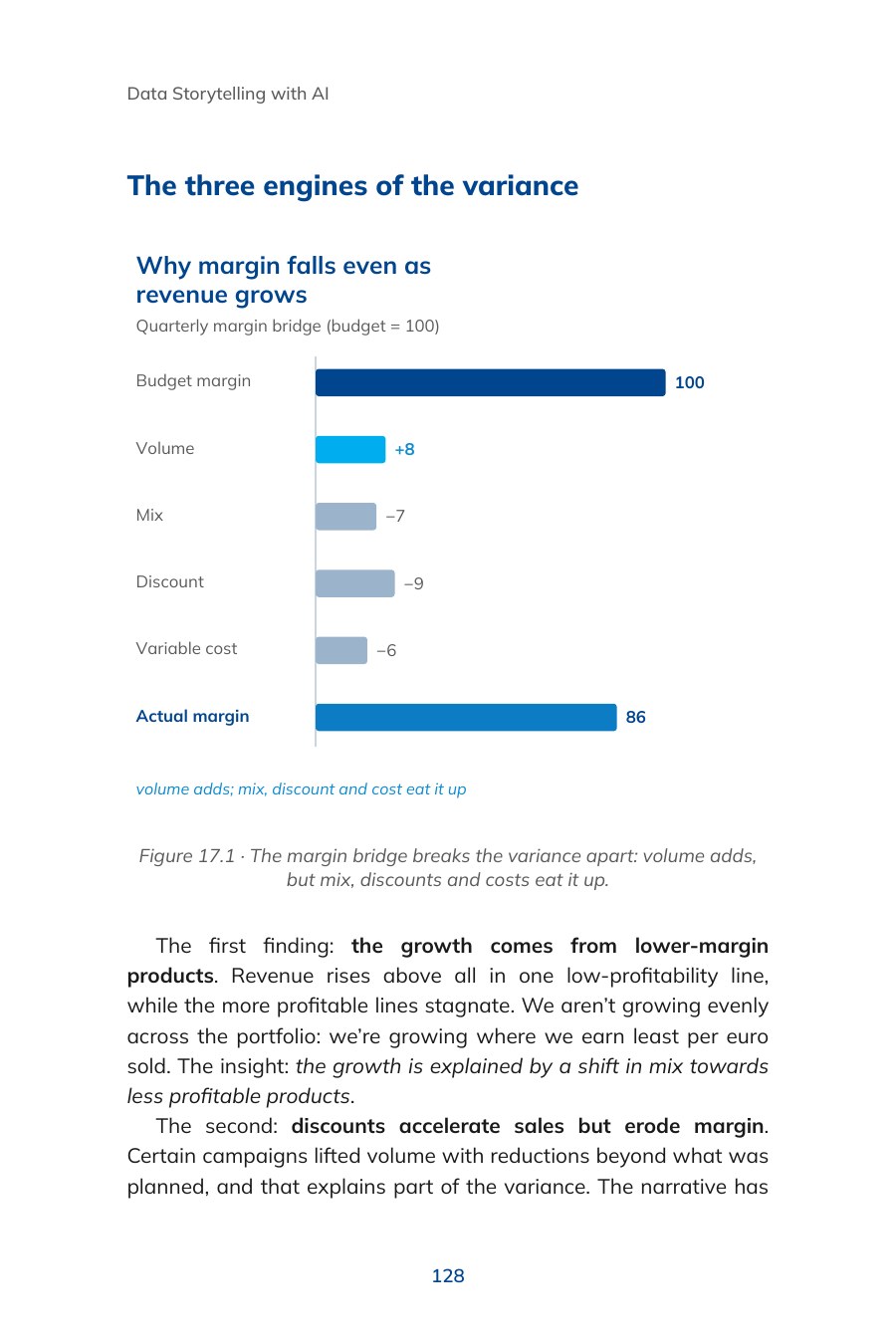
Four pages as they're printed, figures included. Click any one to read it full size.
The assistant
Ask the book
A companion trained on the book's concepts. It won't replace the reading, but it will take a chapter into your own situation: your data, your audience, your decision.
Use it with non-sensitive data. It's a copilot for your thinking, not a source of truth about your business.
Resources
Things you can use on Monday
Part VI of the book is a toolbox: the templates are printed in full, ready to copy onto a whiteboard. The working files, the datasets and the sessions live in the members area.
In the book
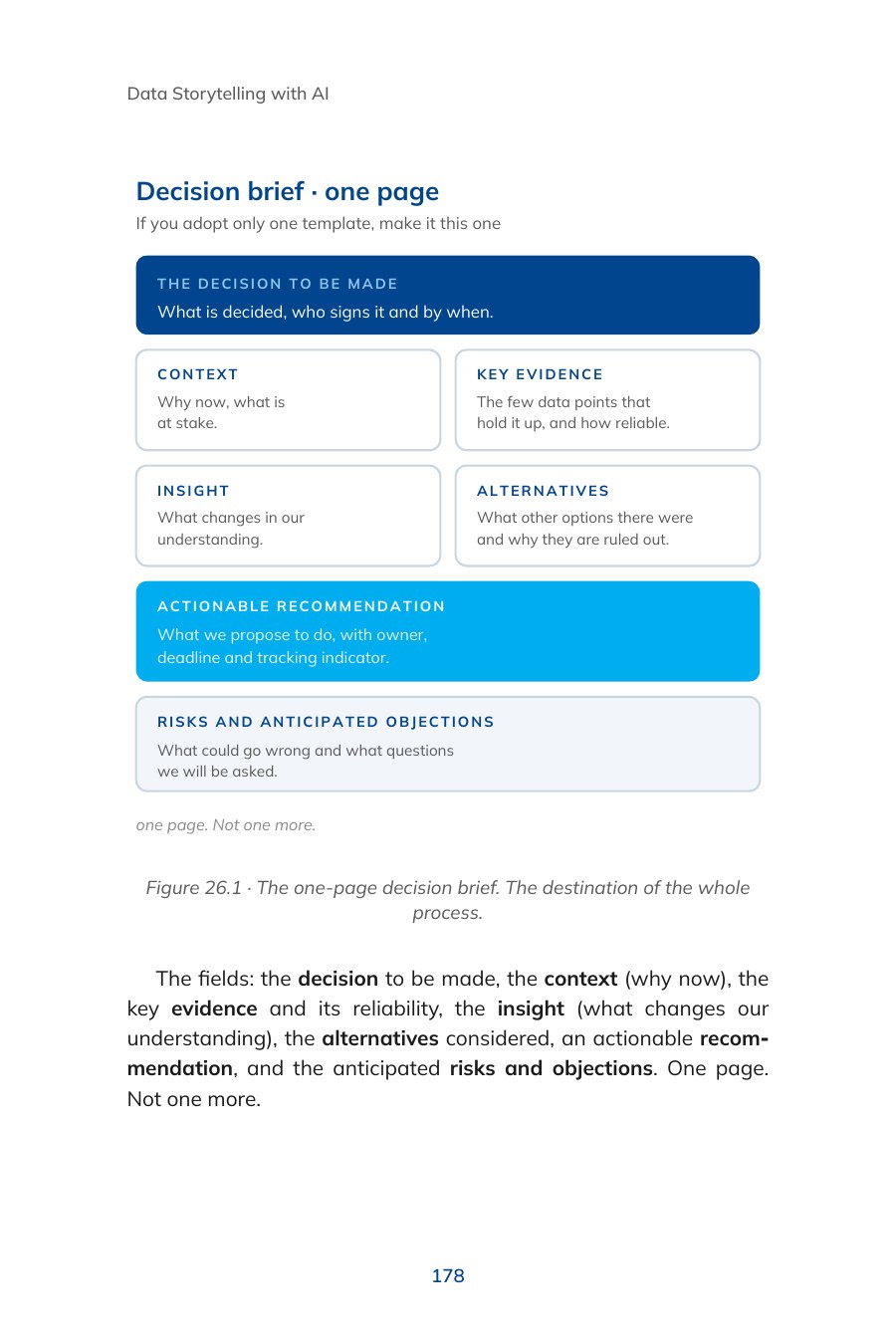
- The decision briefOne page: the decision, the context, the key evidence, the insight, the alternatives, the recommendation, the risks.
- The insight canvasFour steps from data to implication, with the four criteria an insight has to pass.
- The storyline arcSix movements from context to recommendation.
- Prompt library by phasePrompts written to make the model think, not just answer.
- Maturity self-assessmentWhere your team actually stands on each of the four dimensions.
Chapters 25 to 28. Printed in full, no download required.
Members area
- Editable templatesThe canvases as working files, in the formats your team already uses.
- Practice datasetsSmall, messy and realistic. Built to walk the method end to end.
- Worked casesThe full trail of a case: raw data, prompts used, drafts, and the final brief.
- Live sessionsWorking sessions where we take a real problem through F.I.N.D.
Not open yet. Leave your email and I'll write to you the day it is.
Contact
Talk to me
If you're weighing a training programme for your team, want to know what the members area includes, or simply have a question about the book, write to me. I read everything myself.
Or write directly to info@ignasialcalde.es